Indefinite Article in german: in this lesson you will learn the forms of the indefinite article in german. lesson in english. Ein, Eine
Indefinite articles Even though the German nouns can be masculine, feminine or neuter, there are only two forms of indefinite articles:
– Ein is the indefinite article for masculine and neuter nouns
ex: der Baum – ein Baum (a tree); der Garten – ein Garten (a garden); der Onkel – ein Onkel (an uncle)
das Haus – ein Haus (a house); das Boot – ein Boot (a boat); das Kind – ein Kind (a child)– Eine is the indefinite article for feminine nouns
ex: die Blume – eine Blume (a flower); die Suppe – eine Suppe (a soup); die Tante – eine Tante(an aunt) The plural indefinite article doesn’t exist in German:
articles: in this lesson you will learn The definite articles in german. In german there are three different genders for the article: masculine, feminine and neutral. lesson in english.
In English the only definite article is the, which is used for all nouns, singular and plural. On the contrary, in German nouns can be preceded by 4 different definite articles, according to gender –masculine, feminine or neuter – and number – singular or plural.
– The definite article for masculine singular nouns is der
– The definite article for feminine singular nouns is die
– The definite article for neuter singular nouns is das
– The only definite article for all plural nouns is die.
Ex: die Blume / die Blumen (the flowers); der Baum / die Bäume (the trees); das Kind / die Kinder (the children)
Generally speaking, a specific rule which allows to recognize the gender of a noun doesn’t exist. All you can do is memorize every new noun with its definite article. Nevertheless, there are some useful tips that help to guess nouns gender.
1) For example, it’s easy to assign the correct definite article to people’s common nouns.
Feminine Masculine
Die Mutter – The mother Der Vater – the father
Die Tochter – The daughter Der Sohn – the son
Die Oma – the grandmother Der Opa – the grandfather
Die Frau – the woman Der Mann – the man
*An exception is: das Mädchen – the girl, because in German the suffix -chen is generally used to form diminutives which are always neuter.
Compare:
Der Mann – the man and das Männchen – the little man
2) The names of seasons, months and days are masculine
3) The points of the compass are masculine too:
Der Norden – the North
Der Süden – the South
Der Osten – the East
Der Westen – the West
4) Car brands are also masculine.
Ex: Der Mercedes, der Volkswagen
5) Numbers and plant names are instead feminine.
6) Letters, notes and units are neuter
N.B. In German not only proper nouns, but also common nouns start with a capital letter.
Verb to be, personal pronouns, simple present of verb to be in german: in this lesson you will learn the verb to be in german, verb sein, in a formal and informal context. lesson in english.
Personal pronouns
German language is characterised by many personal pronouns because, unlike English grammar, it has four different cases. This lesson is about the personal pronouns of the first case, which are the simplest and the most important.
The pronouns are:
Ich – I
Wir – we
Du – you
Ihr – you
Er, Sie, Es – he/she/it
Sie – they
The plural pronoun Sie is used both as the equivalent of the English they and the formal way to address a stranger or an authority.
Simple present of to be
After memorizing personal pronouns, you can now have a look at the conjugation of the simple present of sein – to be
Ich bin– I am
Wir sind– we are
Du bist– you are
Ihr seid – you are
Er/Sie/Es ist– he/she/it is
Sie sind– they are
As the English to be, sein is an irregular verb. It is used in several fixed expressions, so here is a list of some of them:
In German, all nouns are capitalized. For example, "my name" is "mein Name," and "the apple" is "der Apfel." This helps you identify which are the nouns in a sentence.
Three grammatical genders, three types of nouns
Nouns in German are either feminine, masculine or neuter. For example, "Frau" (woman) is feminine, "Mann" (man) is masculine, and "Kind" (child) is neuter. The grammatical gender may not match the biological gender: "Mädchen" (girl) is a neuter noun.
It is very important to learn every noun along with its gender because parts of German sentences change depending on the gender of their nouns.
Generally speaking, the definite article "die" (the) and the indefinite article "eine" (a/an) are used for feminine nouns, "der" and "ein" for masculine nouns, and "das" and "ein" for neuter nouns. For example, it is "die Frau," "der Mann," and "das Kind." However, later you will see that this changes depending on something called the "case of the noun."
masculine
neuter
feminine
indefinite (a/an)
ein Mann
ein Mädchen
eine Frau
definite (the)
der Mann
das Mädchen
die Frau
Conjugations of the verb sein (to be)
A few verbs like "sein" (to be) are completely irregular, and their conjugations simply need to be memorized:
German
English
ich bin
I am
du bist
you (singular informal) are
er/sie/es ist
he/she/it is
wir sind
we are
ihr seid
you (plural informal) are
sie sind
they are
Sie sind
you (formal) are
Conjugating regular verbs
Verb conjugation in German is more challenging than in English. To conjugate a regular verb in the present tense, identify the invariant stem of the verb and add the ending corresponding to any of the grammatical persons, which you can simply memorize:
trinken (to drink)
English person
ending
German example
I
-e
ich trinke
you (singular informal)
-st
du trinkst
he/she/it
-t
er/sie/es trinkt
we
-en
wir trinken
you (plural informal)
-t
ihr trinkt
you (formal)
-en
Sie trinken
they
-en
sie trinken
Notice that the 1st and the 3rd person plural have the same ending as "you (formal)."
Umlauts
Umlauts are letters (more specifically vowels) that have two dots above them and appear in some German words like "Mädchen." Literally, "Umlaut" means "around the sound," because its function is to change how the vowel sounds.
An umlaut can sometimes indicate the plural of a word. For example, the plural of "Mutter" (mother) is "Mütter." It might even change the meaning of a word entirely. That's why it's very important not to ignore those little dots.
No continuous aspect
In German, there's no continuous aspect, i.e. there are no separate forms for "I drink" and "I am drinking". There's only one form: Ich trinke.
There's no such thing as Ich bin trinke or Ich bin trinken!
When translating into English, how can I tell whether to use the simple (I drink) or the continuous form (I am drinking)?
Unless the context suggests otherwise, either form should be accepted.
In English, the words "he" and "I" can be used as subjects (the ones doing the action in a sentence),
and they change to "him" and "me" when they are objects (the ones the action is applied to). For example, we say "He likes me" and "I like him." This is exactly the notion of a "grammatical case:" the same word changes its form depending on its relationship to the verb. In English, only pronouns have cases, but in German most words other than verbs have cases: nouns, pronouns, determiners, adjectives, etc.
Understanding the four German cases is one of the biggest hurdles in learning the language. The good news is that most words change very predictably so you only have to memorize a small set of rules. We'll see more about cases later, but for now you just need to understand the difference between the two simplest cases: nominative and accusative.
The subject of a sentence (the one doing the action) is in the nominative case.
So when we say "Die Frau spielt" (the woman plays), "Frau" is in the nominative.
The accusative object is the thing or person that is directly receiving the action. For example, in "Der Lehrer sieht denBall" (the teacher sees the ball), "Lehrer" is the nominative subject
and
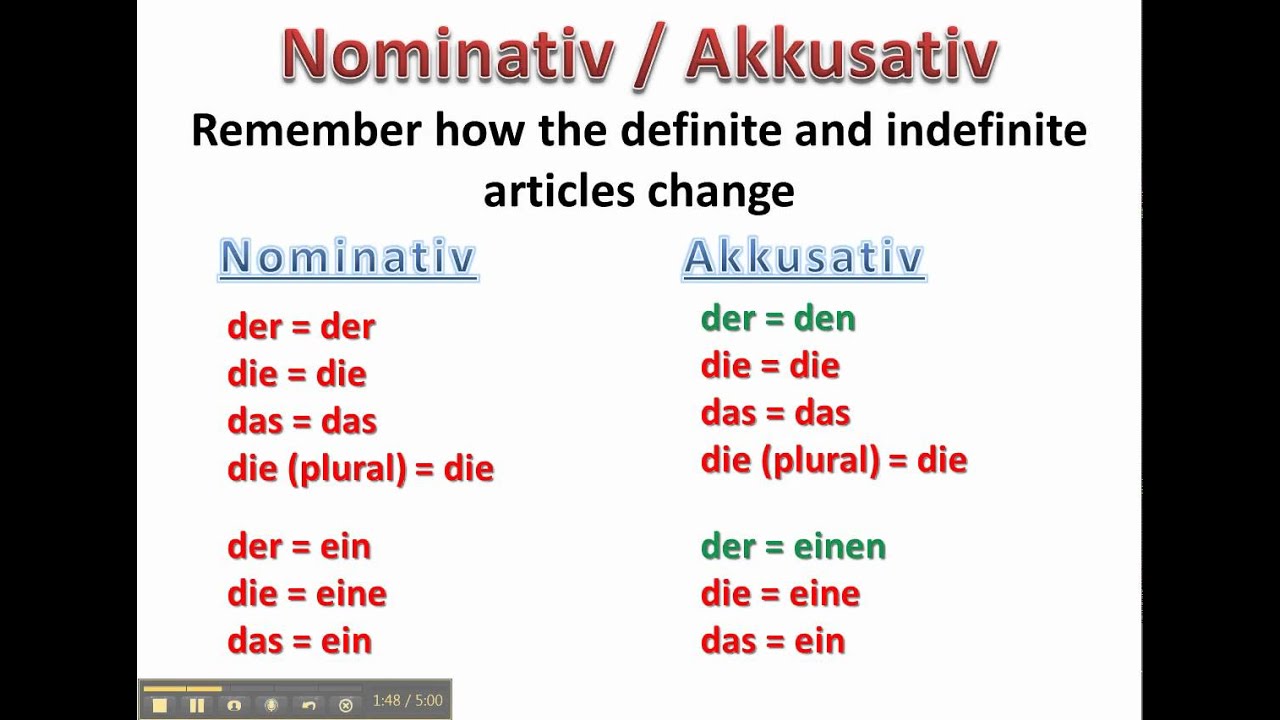
"Ball" is the accusative object. Notice that the articles for accusative objectsare not the same as the articles in the nominative case:
"the" is "der" in the nominative case and "den" in the accusative.
The following table shows how the articles change based on these two cases:
Case
Masculine
Feminine
Neuter
Plural
Nominative
der
die
das
die
Accusative
den
die
das
die
Case
Masculine
Feminine
Neuter
Nominative
ein
eine
ein
Accusative
einen
eine
ein
The fact that most words in German are affected by the case explains why the sentence order is more flexible than in English. For example, you can say "Das Mädchen hat den Apfel" (the girl has the apple) or "Den Apfel hat das Mädchen." In both cases, "den Apfel" (the apple) is the accusative object, and "das Mädchen" is the nominative subject.
------------------------------------------
Conjugations of the verb sein (to be)
The verb "sein" (to be) is irregular, and its conjugations simply need to be memorized:
German
English
ich bin
I am
du bist
you (singular informal) are
er/sie/es ist
he/she/it is
wir sind
we are
ihr seid
you (plural informal) are
sie sind
they are
Sie sind
you (formal) are
Conjugations of the verb essen (to eat)
The verb "essen" (to eat) is slightly irregular in that the stem vowel changes from e to i in the second (du isst) and third person singular (er/sie/es isst) forms.
English person
ending
German example
I
-e
ich esse
you (singular informal)
-st
du isst
he/she/it
-t
er/sie/es isst
we
-en
wir essen
you (plural informal)
-t
ihr esst
you (formal)
-en
Sie essen
they
-en
sie essen
How can you hear the difference between isst and ist?
You can't. "isst" and "ist" sound exactly the same. In colloquial (rapid) speech, some speakers drop the "t" in "ist".
So "Es ist ein Apfel" and "Es isst ein Apfel" sound the same?
Yes, but you can tell it's "Es ist ein Apfel" because "Es isst ein Apfel" is ungrammatical. The accusative of "ein Apfel" is "einen Apfel". Hence, "It is eating an apple" translates as "Es isst einen Apfel."
-----------------
The verb haben (to have)
In English, you can say "I'm having bread" when you really mean that you're eating or about to eat bread. This does not work in German. The verb haben refers to possession only. Hence, the sentence Ich habe Brot only translates to I have bread, not I'm having bread. Of course, the same applies to drinks. Ich habe Wasser only translates to I have water, not I'm having water.
In English, the present tense can be simple or progressive (as in "I eat" or "I am eating"). Both forms translate to just one German present tense form, because there is no continuous tense in standard German. So, "she learns" and "she is learning" are both "sie lernt."
WIE GEHT'S?
There are many ways to ask someone how he or she is doing. Take "How are you?," "How do you do?" and "How is it going?" as examples. In German, the common phrase or idiom uses the verb "gehen" (go): "Wie geht es dir?" (How are you?).
WILLKOMMEN CAN BE A FALSE FRIEND
In German, "Willkommen" means welcome as in "Welcome to our home", but it does not mean welcome as in "Thank you - You're welcome". The German for the latter is "Gern geschehen" or "Keine Ursache".
In English, making plurals out of singular nouns is typically as straightforward as adding an "s" or an "es" at the end of the word. In German, the transformation is more complex, and also the articles for each gender change. The following five suggestions can help:
-e ending: most German one-syllable nouns will need-ein their plural form.
For example, in the nominative case, "das Brot" (the bread) becomes"dieBrote,"
and "das Spiel" (the game) becomes"die Spiele.
-er ending: most masculine or neuter nouns will need the -er ending, and there may be umlaut changes. For example, in the nominative case
"das Kind" (the child)becomes"dieKinder," and "der Mann" (the man)becomes"die Männer."
-n/-en ending: most feminine nouns will take either -n or -en in all four grammatical cases, with no umlaut changes. For example, "die Frau" (the woman) becomes "die Frauen" and "die Kartoffel"becomes "dieKartoffeln."
-s ending: most foreign-origin nouns will take the -s ending for the plural, usually with no umlaut changes.
For example: "der Chef" (the boss) becomes "die Chefs."
There is no change for most neuter or masculine nouns that contain any of these in the singular:-chen, -lein, -el, or -er. There may be umlaut changes.
For example:"das Mädchen" (the girl) becomes "die Mädchen," and "die Mutter" (the mother) becomes "die Mütter."
German feminine plurals - nouns ending in -in
Feminine nouns that end in "-in" will need "-nen" in the plural. For example, "die Köchin" (the female cook) becomes "die Köchinnen" in its plural form.
ihr vs er
If you're new to German, ihr and er may sound exactly same, but there is actually a difference. ihr sounds similar to the English word ear, and er sounds similar to the English word air (imagine a British/RP accent).
Don't worry if you can't pick up on the difference at first. You may need some more listening practice before you can tell them apart. Also, try using headphones instead of speakers.
Even if this doesn't seem to help, knowing your conjugation tables will greatly reduce the amount of ambiguity.